Death Stranding 2: On the Beach – A Remarkable Recovery for Kojima’s Divisive Franchise
Death Stranding 2: On the Beach refines Hideo Kojima’s visionary gameplay and narrative, offering a more accessible, engaging sequel.
When Death Stranding first arrived, it split the gaming world down the middle. Enthusiasts celebrated Hideo Kojima’s audacious post-apocalyptic courier fantasy, while a vocal segment of players found it a tedious trek through stunning but empty landscapes. Years later, that division has faded into memory for many who have now ventured into Death Stranding 2: On the Beach. Where the original often felt like an acquired taste, its sequel manages to distill the strangeness into an adventure that is both more playful and more accessible, without losing the DNA that made the first game so distinctive. What emerges is a title that feels closer than ever to the heights of Kojima’s earlier masterpieces, a rare case of a sequel learning exactly the right lessons from its predecessor’s missteps.
Death Stranding 2 picks up with Sam Bridges living in quiet isolation, raising a toddler version of Lou, the BB unit from his first journey. That fragile peace quickly shatters. A series of calamities pulls Sam back into the porter\u2019s life, this time across the sprawling terrains of Mexico and Australia. Guided by his old companion Fragile, he assembles a motley crew aboard the DHV Magellan, a colossal ship that serves as a mobile base of operations. The narrative remains as dense and symbol-laden as fans would expect, filled with cryptic acronyms, surreal imagery, and world-rewriting revelations, but the pacing has undergone a dramatic transformation. Where the first game indulged in marathon cutscenes that sometimes drained momentum, On the Beach delivers snappier, more kinetic sequences that keep the story hurling forward. Over-the-top action beats, the kind Kojima perfected in the Metal Gear Solid series, finally assert themselves here, blending spectacle with the franchise\u2019s trademark head-scratching lore. The result is a plot that is far easier to invest in, even if it still struggles to fully ground its emotional stakes.
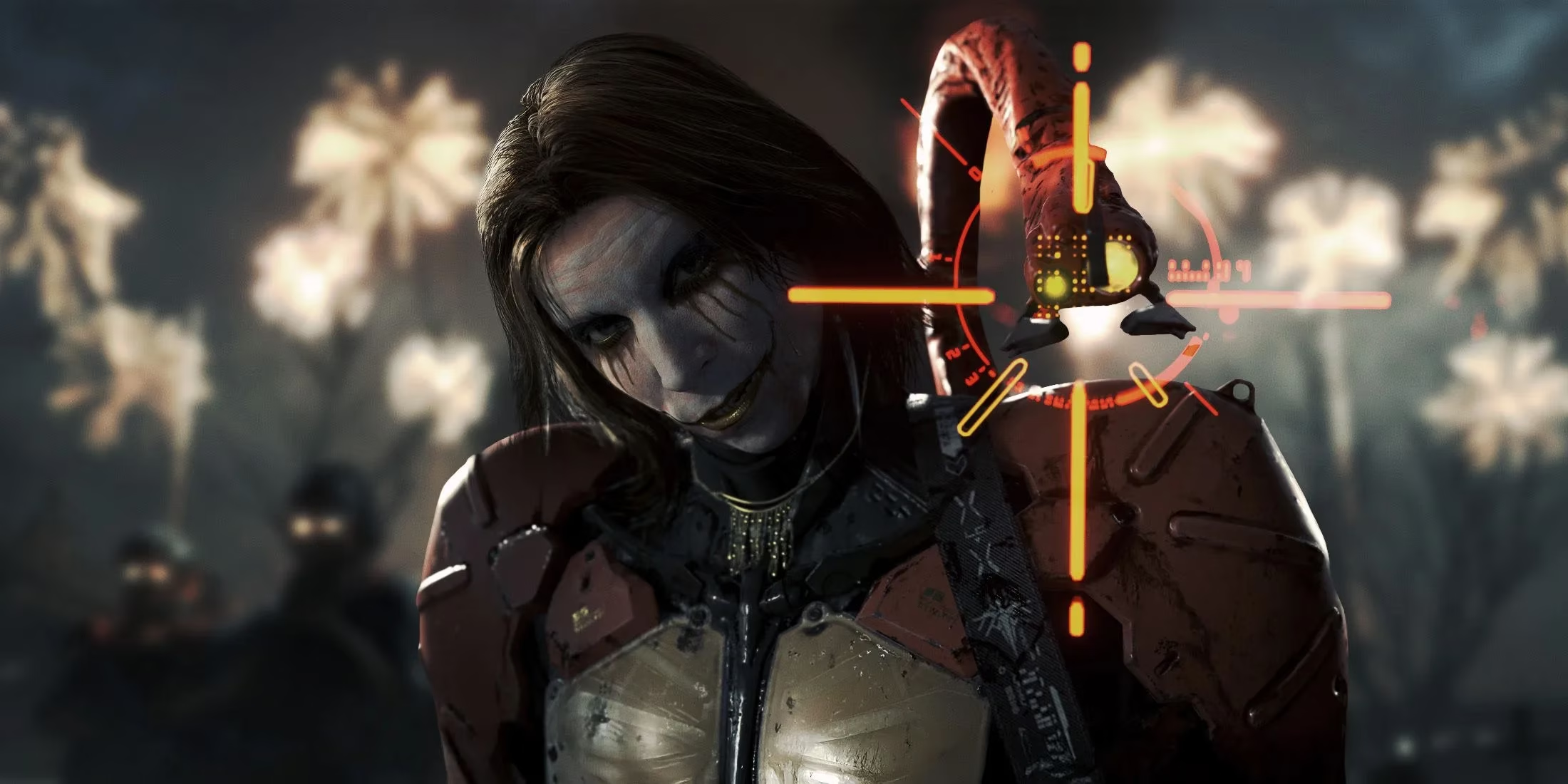
That emotional disconnect largely stems from the characters themselves. Despite a phenomenal cast that includes Norman Reedus, L\u00e9a Seydoux, and Troy Baker, the script often traps its actors in a web of exposition and jargon. Conversations can feel less like human interaction and more like living encyclopedias reciting lore at one another. Critical moments that should land with gut-wrenching weight sometimes pass by with a shrug, simply because the characters do not react in recognizably human ways. Troy Baker\u2019s return as the magnetic and unhinged Higgs is a notable exception; his chaotic energy injects a much-needed dose of personality into every scene he steals. The game\u2019s most memorable figure, Higgs, embodies the sequel\u2019s embrace of camp and menace in equal measure.
Where the original gameplay could feel like forcing a horse up an impossibly steep mountain, the sequel transforms deliveries into a genuine sandbox of creativity. The core loop\u2014transporting cargo from point A to point B\u2014remains, but the toolset expands at an exhilarating pace. Players are handed floating carriers to levitate heavy loads up vertical cliffs, robust cargo trucks to barrel through hostile territories, and an ever-growing arsenal of gadgets that let them sculpt a personal approach to every route. The map itself becomes a canvas; the freedom to chart a path through treacherous deserts or snow-capped peaks is genuinely liberating. One moment, you might be cruising across a sunbaked plain when a sudden ambush by bandits turns a routine drive into a frantic scramble for survival. On another, a carefully planned shortcut over a glacier is obliterated by a sudden avalanche, scattering cargo and dignity in equal measure. These dynamic, unscripted \u201cwater-cooler moments\u201d are what keep the traversal from ever settling into a predictable rhythm.
Combat, long a secondary concern in the first game, has blossomed into a genuine highlight. Engagements with human raiders, spectral BTs, and the new ghost mechs are tense and versatile. Stealth purists can sneak through camps, subduing enemies with Sam\u2019s strand rope, while more aggressive players can roll in with assault rifles and enough blood bags to fuel a vampire banquet. Boss fights have also received a massive upgrade. Colossal animalistic BTs that flood the terrain with tar force split-second decisions: stand and fight, risking a single fatal gulp, or flee through the muck with damaged cargo. These encounters, especially when they trigger near the end of a grueling delivery, generate an anxiety that borders on horror. On top of these organic battles, scripted boss duels deliver the over-the-top choreography that feels ripped straight from a blockbuster action film.
Perhaps the most quietly ingenious feature, however, is the returning Social Strand System. Although players never meet face-to-face, the world is shaped by collective effort. A bridge you did not build might save you from a river crossing; a generator someone else placed could power your vehicle across the final stretch of a desperate journey. Hearing the distant shouts of other porters or finding a cache of shared supplies in a blizzard forges a silent camaraderie that is unlike anything else in the medium. It is a system that transforms isolation into a cooperative network, turning the gruelling loneliness of the post-apocalypse into a shared act of gentle rebellion.
Visually, On the Beach is a stunner. The draw distance is absurd, the textures pristine, and the lighting so precise that the world often looks like a meticulously composed photograph. Clicking the right stick to pan the camera over a sweeping landscape is not just a tool; it is an invitation to marvel. The soundtrack, curated to perfection, swells just as a vista opens up, turning a simple hike into a cinematic pilgrimage. It is, without exaggeration, one of the finest-looking titles on the PlayStation 5 to date.
Still, the mission structure does not entirely escape the pull of repetition. The loop of accepting orders via hologram, delivering, returning to a private room, and rinsing can settle into a trance-like grind, especially in the back half of the campaign. The environmental variety and the sporadic injection of novel objectives do plenty to stave off exhaustion, but players who demand constant narrative propulsion may find themselves checking the clock. The dialogue, too, remains a sticking point. For every scene that crackles with Kojima\u2019s signature style, there is a sequence so buried in terminology that it threatens to collapse under its own weight.
For those who bounced hard off the original Death Stranding, On the Beach offers a genuine and often breathtaking redemption. It takes the sprawling, meditative skeleton of its predecessor and grafts on a more energetic heart, a wider freedom of approach, and combat that finally feels like more than an afterthought. The core eccentricities remain\u2014the obsessive delivery tracking, the earnest philosophising, the sheer weirdness\u2014but they are now wrapped in a package that invites players in rather than pushing them away. While a handful of flaws prevent it from sitting comfortably alongside the very best of Kojima\u2019s catalogue, Death Stranding 2: On the Beach is a journey absolutely worth taking, and proof that even the most divisive visions can find their stride the second time around.