Death Stranding 2: Restoring All 9 Mines and Monorail Lines in 2026
Death Stranding 2 mine locations guide reveals all nine Australian mines, materials, restoration tips, upgrades, and monorail connections.
I have spent a lot of my time in Death Stranding 2: On the Beach rebuilding Australia, and the mine network is one of the most satisfying logistics projects in the game. As of 2026, the loop remains simple but powerful: restore a mine, feed it Chiral Crystals, and harvest bulk materials that would otherwise trickle in from facilities or MULE camps. Mines are not just optional side content. They are material engines, and when they sit on a monorail line they become part of a fast cargo network that can move huge loads between stops.
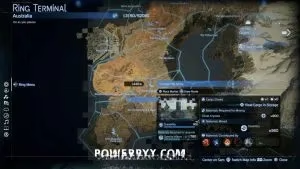
Two trophies are tied directly to mines: Dig, Dig, Dig! for restoring three mines, and Rail Restorer for restoring and fully reopening a monorail line. I recommend going beyond those numbers. Online player contributions count toward repairs, so if you are connected you do not need to supply every material yourself. If you play offline, you will need to contribute the full amount, so plan your hauls.
Most mines can be upgraded after restoration. Upgrades let me mine more materials for the same number of Chiral Crystals. Mines degrade over time because of Timefall and natural disasters, just like other structures. If durability runs out before I use them again, I repair them. There are no mines in Mexico. All nine are in Australia. The list below follows the approximate order I restored them as I progressed through the story.
| # | Mine | Material Mined | Monorail Connection | Restoration Notes |
|---|---|---|---|---|
| 1 | Smoke Hill Mine | Ceramics | None | Sub Order 104 from Western Environmental Observatory |
| 2 | Mine North of F1 | Special Alloys | West Monorail Line | Main Order 013 from West Fort Knot (F1) |
| 3 | Twin Valley Mine | Chemicals | None | Approximate story order |
| 4 | Mine Near F3 Crater | Resins | West Monorail Line | Approximate story order |
| 5 | Northeastern Mine | Metals | East Monorail Line | Approximate story order |
| 6 | Savanna Mine | Special Alloys | None | Approximate story order |
| 7 | Mine North of Tar Lake | Ceramics | Central Monorail Line | Approximate story order |
| 8 | Mine North of F6 | Resins | East Monorail Line | Approximate story order |
| 9 | South Edge Mine | Metals | None | Approximate story order |
1 – Smoke Hill Mine
Material Mined: Ceramics. I restored this mine during Sub Order 104, available from Western Environmental Observatory. Ceramics are always in demand for roads, structures, and gear, so getting a dedicated source early made my building projects much smoother. 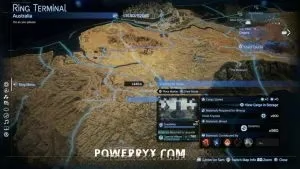
2 – Mine North of F1
Material Mined: Special Alloys. This one is completed during Main Order 013, available from West Fort Knot (F1). It is connected to the West Monorail Line. Special Alloys are valuable for high-end fabrication, and the monorail link means I can move large batches without long truck routes. 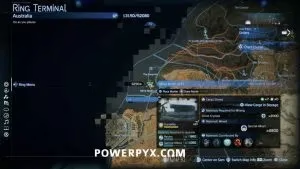
3 – Twin Valley Mine
Material Mined: Chemicals. Twin Valley Mine is another early restoration target. Chemicals feed into explosives, medical supplies, and advanced equipment. Even without a monorail connection, I found it worth restoring because it reduced my reliance on facility restocks. 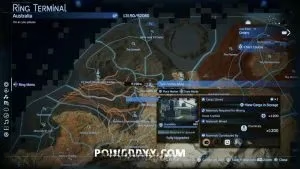
4 – Mine Near F3 Crater
Material Mined: Resins. This mine is connected to the West Monorail Line. Resins are used in containers and other gear, and the monorail connection makes it easy to pair with Mine North of F1 for a West line material run. 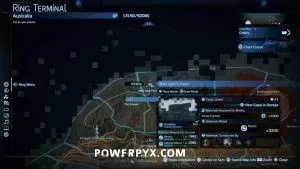
5 – Northeastern Mine
Material Mined: Metals. Connected to the East Monorail Line. Metals are the bread and butter of road and structure construction. Once this mine is running, I can stop scavenging every small metal cache in MULE territory. 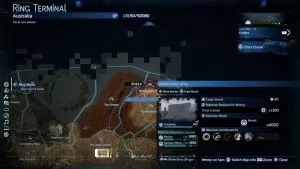
6 – Savanna Mine
Material Mined: Special Alloys. Savanna Mine gives another Special Alloys source. It is not connected to a monorail line, but it is still useful for players who want to upgrade gear and build advanced structures without waiting on facilities. 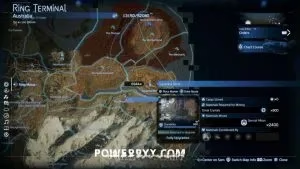
7 – Mine North of Tar Lake
Material Mined: Ceramics. Connected to the Central Monorail Line. This is one of my favorite mines because the Central line lets me distribute ceramics across multiple facilities quickly. If I am rebuilding roads, this mine becomes a regular stop. 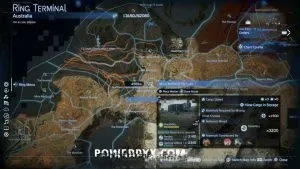
8 – Mine North of F6
Material Mined: Resins. Connected to the East Monorail Line. Together with Northeastern Mine, this creates a strong East line loop for metals and resins. I can load a monorail, drop materials at several stops, and never touch a truck. 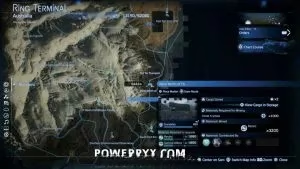
9 – South Edge Mine
Material Mined: Metals. South Edge Mine is a late-game metals source. It is not on a monorail line, but it helps top off large construction projects. I usually restore it after the main story pushes me south. 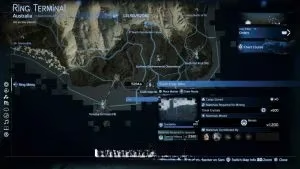
My 2026 Mine Strategy
-
Prioritize mines on monorail lines first. They give the best return because cargo moves faster and in larger amounts.
-
Upgrade mines whenever possible. More material per Chiral Crystal is always worth it.
-
Let online contributions help. If you are connected, you do not have to fund every repair alone.
-
Repair mines after Timefall and disasters. A degraded mine cannot be used until durability is restored.
-
Use mines to avoid MULE camp grinding. A restored mine is a cleaner, more reliable material faucet.
-
Link mines with facilities. The real power comes from moving mined materials directly into production and delivery loops.
In 2026, I still think mines are one of the best investments in Death Stranding 2: On the Beach. They turn Chiral Crystals into construction freedom. Restore all nine, reopen every monorail line, and Australia becomes a connected network instead of a chore. The trophies are just the beginning.