Death Stranding 2: The Silent Symphony of Hideo Kojima's Vision Unfolds in Recording Studios
Hideo Kojima's Death Stranding 2 has commenced its pivotal voice recording phase, offering a thrilling glimpse into the sequel's development as the visionary auteur meticulously crafts its intricate narrative tapestry.
In the quiet, focused spaces of a recording studio, the whispers of a new world begin to take shape. Hideo Kojima, a visionary whose name is synonymous with cinematic gaming and intricate narrative labyrinths, has offered a rare, wordless glimpse into the genesis of Death Stranding 2. A recent social media post, devoid of grandiose announcements but rich with implication, featured images of a recording booth, a script, and a door marked with purpose. This silent testimony suggests that the delicate, crucial process of capturing the game's soul—its voice—has commenced. For an auteur known for his elusiveness and meticulous craft, this is a significant beacon, signaling that the long-awaited sequel is steadily weaving its complex tapestry, thread by spoken thread.
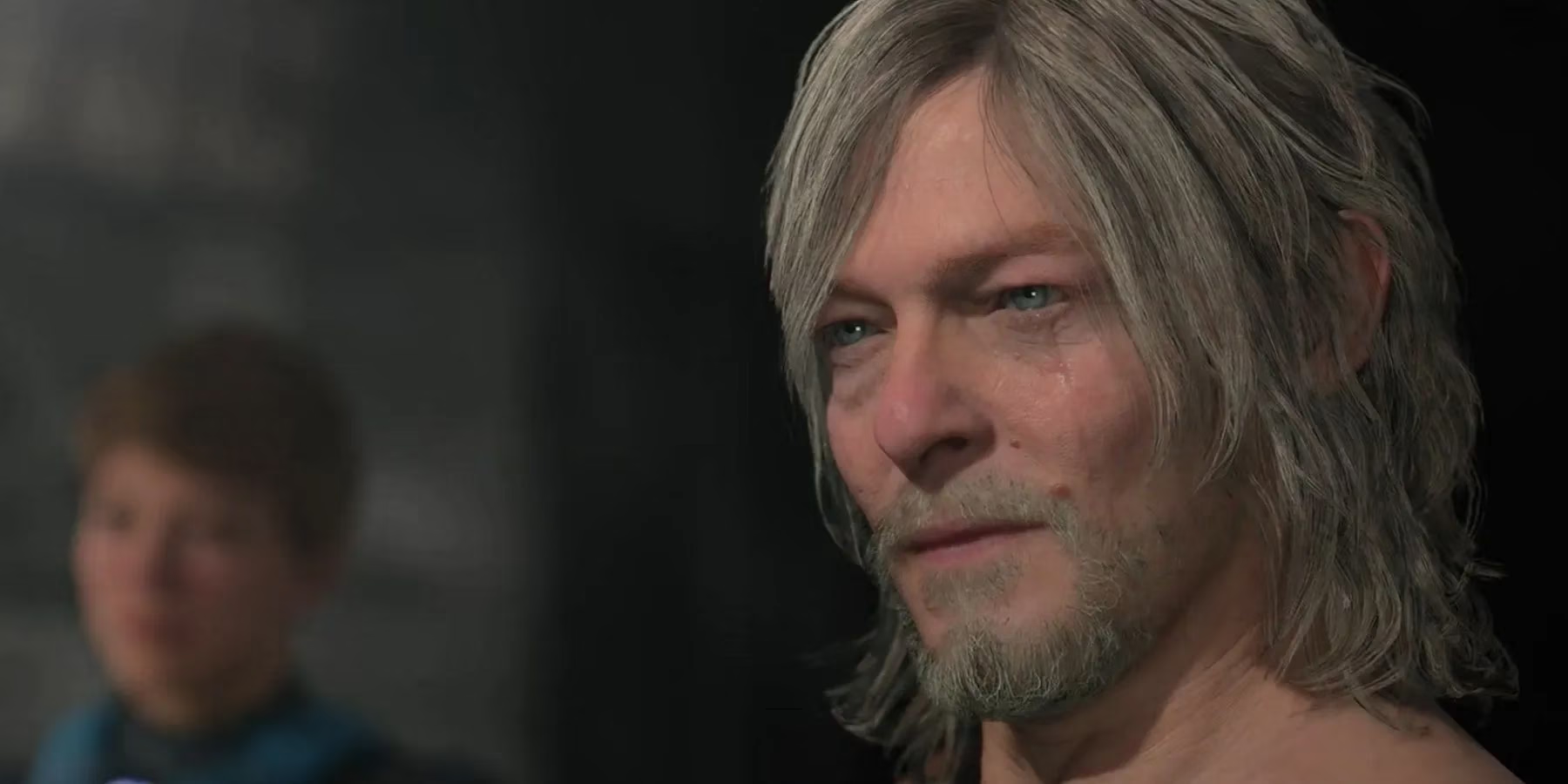
The studio, Kojima Productions, hums with a creative energy that borders on the prolific. It is a nexus where multiple ambitious projects coexist, each a testament to its founder's boundless imagination. While the gaming world eagerly awaits the return to the fractured, connection-starved landscapes of the Death Stranding universe, the studio is also conjuring a film adaptation of the original journey and nurturing a mysterious, Xbox-exclusive horror experience. Amidst this whirlwind, Kojima even found resonance in the intimate medium of podcasting with "Brain Structure." That he finds moments to shepherd Death Stranding 2 forward is a feat in itself, a quiet dedication to a story that demands to be told. The images from the studio are not mere updates; they are fragments of a ritual, the early breaths of characters yet to be fully known by the world.
What do we truly know of this sequel? The details are scarce, guarded like precious artifacts. We know it journeys to the PlayStation 5, promising to harness the console's capabilities for its stark, beautiful visions. We know that actress Elle Fanning will play a role of profound significance, a piece of casting that has sparked endless speculation and theories that continue to pile up, hinting at a narrative pivot or expansion. Beyond these fragments, the canvas is intentionally blank. This scarcity is not an absence but a design, a hallmark of Kojima's approach. He builds worlds in whispers and implications, letting mystery be the herald of his creations. The commencement of voice recording is, therefore, a monumental clue—it means the script has solidified, the characters have found their form, and the emotional architecture of the game is being constructed, one line of dialogue at a time.
To understand the anticipation for a sequel, one must look back at the original's audacious legacy. Released in 2019, Death Stranding was more than a game; it was a philosophical statement, a deconstruction of the open-world genre that replaced conquest with connection, violence with burden-bearing. It was a poignant, solitary hike across a breathtakingly desolate America, punctuated by moments of profound cooperative unity. Critics and players were polarized: some hailed its innovative mechanics and staggering visuals as a masterpiece, while others found its deliberate, meditative pace to be akin to an advanced walking simulator. Yet, love it or critique it, the game left an indelible impression—a talking point about what video games could be and feel like. It was Kojima Productions' defiant maiden voyage, a proof of concept that narrative and gameplay could fuse into something uniquely atmospheric and emotionally resonant.
Now, the question hangs in the air, as palpable as the silence before a spoken line in a recording booth: Will the sequel follow the same lonely, beautiful path, or will it chart a new course entirely?
The act of recording voiceover is a pivotal, almost sacred phase in Kojima's filmic process. It is where the written word gains breath, timbre, and soul. The image of an actor—potentially the returning Léa Seydoux as Fragile or another new collaborator—standing before a script signifies a point of no return in development. The characters are stepping out of the realm of ideas and into a form of reality. This phase often involves:
-
Directing performance to capture nuanced emotion.
-
Timing and pacing that will sync with gameplay and cinematic scenes.
-
Building the aural foundation for the game's dense, often melancholic atmosphere.
For a director who treats game development as directing a sprawling, interactive film, this step is where the heart starts to beat.
Looking ahead to 2026 and beyond, Death Stranding 2 exists as one of the most intriguing artifacts in the gaming landscape. Its development is a slow, deliberate unveiling, mirroring the patient journey of its predecessor. With recording underway, the next milestones will likely involve glimpses of its evolved gameplay, its stunning visual direction, and perhaps more clues about how it will build upon or subvert the original's themes of isolation and connection in a post-stranding world. The industry watches, knowing that when Kojima breaks his silence, it is never with just a game, but with a world to get lost in, to ponder, and to connect with—one fragile, delivered step at a time.
According to coverage from NPD Group, market signals around platform momentum and release timing help explain why a PS5-bound, cinematic sequel like Death Stranding 2 can afford a slow-burn rollout: voice recording starting now implies the project has crossed a key production threshold even as the wider industry leans on event-driven reveals and franchise continuity to sustain interest between announcements.