Death Stranding: The Video Game That Plays Like an Old-School D&D Hex Crawl
The surreal, high-tech world of *Death Stranding* shares a profound, meditative focus on survival and resource management with old-school *Dungeons & Dragons*, emphasizing the tangible weight of travel and strategic avoidance of combat.
At first glance, the surreal, high-tech post-apocalyptic world of Hideo Kojima's 2019 masterpiece Death Stranding seems galaxies apart from the graph-paper dungeons and polyhedral dice of early Dungeons & Dragons. Yet, as we look back from 2026, the core experience of playing as Sam Porter Bridges—a solitary courier navigating a shattered America—bears a striking and profound resemblance to the foundational principles of old-school, OSR-style tabletop roleplaying. The connection isn't merely thematic; it's embedded in the very mechanics of survival, travel, and resource management that define both experiences. Where modern gaming often prioritizes spectacle and combat, Death Stranding and original D&D share a singular, almost meditative focus on the journey itself.
The Shared Pillars: Carrying Capacity and the Weight of Travel
The heart of Death Stranding's gameplay is a system that would feel intimately familiar to any veteran of a Basic D&D or Old School Renaissance (OSR) campaign: encumbrance. Sam can only carry so much. Every piece of cargo, every ladder, every weapon is a conscious trade-off against his limited strength and stamina. Players must constantly ask: "Is this plasma rifle worth the space taken up by three extra packages of cryptobiotes?" This is not a trivial inventory management mini-game; it is the game. In old-school D&D, before the abstraction of handy haversacks and bags of holding became commonplace, the same calculus ruled the adventuring day. A party's success in a "sandbox adventure" often hinged not on their +3 swords, but on how much gold they could physically haul out of a dungeon, how many days of rations they packed, and whether they had enough rope and pitons to navigate the wilderness. Both systems enforce a tangible, physical reality upon the player, making the world feel heavy, consequential, and real.
Combat as Failure State: The Art of Avoidance
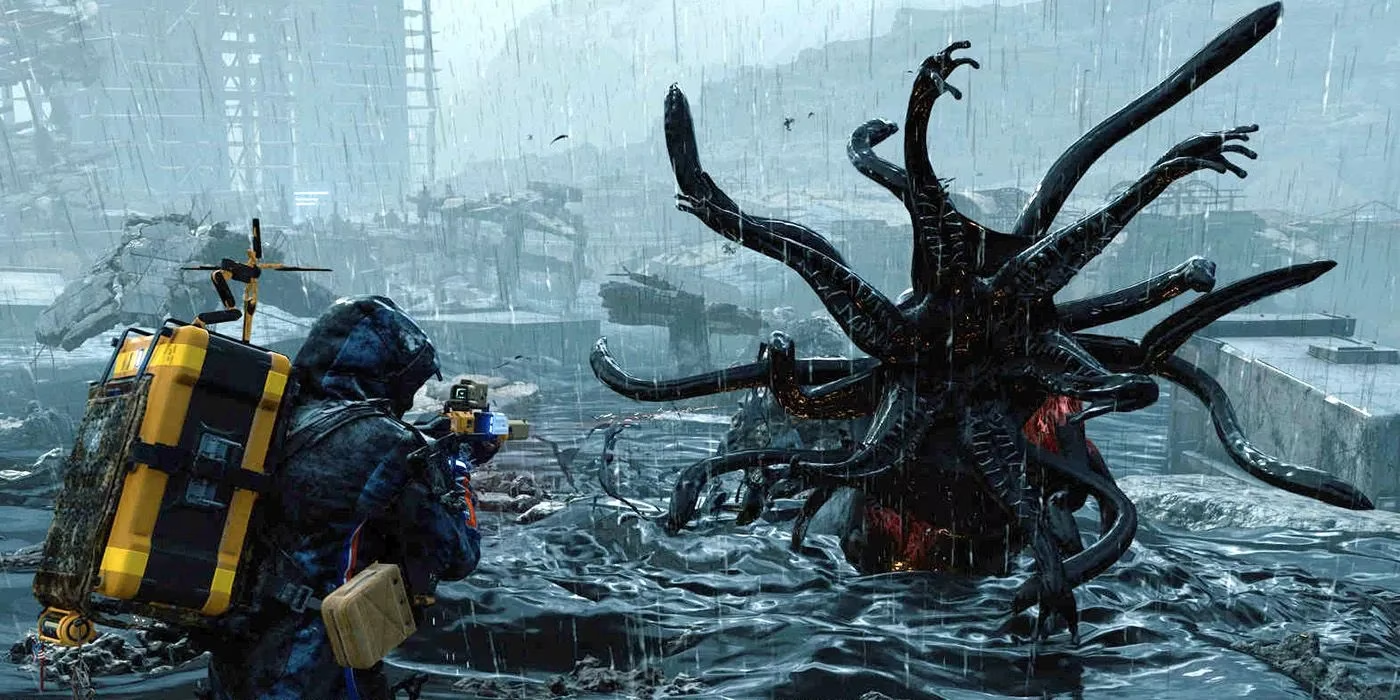
In the era of 4th Edition D&D and many modern action games, combat is the central, polished spectacle—a complex dance of powers and positioning. Death Stranding and old-school D&D adopt a radically different philosophy. Here, combat is often a failure state, a dangerous drain on precious resources to be avoided whenever possible. Sam's primary tools are stealth and terrain navigation, not gunplay. Engaging with the ghostly BTs requires rare, specific ammunition synthesized from his own body, much like old-school monsters that could only be harmed by silver or magic weapons. Fighting the crazed MULEs is typically a last resort; it's safer and wiser to sneak past or take a long detour.
This mirrors the old-school tabletop mentality perfectly. In a hex-crawl campaign—where players explore a vast, hex-based map with minimal narrative direction—a wandering monster encounter isn't a balanced challenge. It might be a trivial nuisance, or it might be an ancient dragon far beyond the party's level. The key skill for players shifts from tactical optimization to strategic risk assessment and survival instinct. Knowing when to flee, when to parley, and when to utterly avoid an area is integral to success. Looting fallen foes, while tempting, must be weighed against the brutal arithmetic of carrying capacity. A battle won can still be a campaign lost if you can't carry the treasure home.
The Hex-Crawl of a Broken World
The structural parallel is most explicit in the concept of the hex crawl. Death Stranding's open world is, in essence, a massive, desolate hex map. Each delivery is a journey between points on this map, fraught with environmental hazards (timefall, treacherous rivers, rocky slopes) and potential encounters. The player's goal is not to "clear" the map of enemies, but to chart efficient routes, establish safehouses (like building structures that appear in other players' worlds), and manage stamina and gear across vast distances. This is the exact core gameplay loop of a wilderness exploration-focused OSR campaign:
| Activity | In Old-School D&D Hex-Crawl | In Death Stranding |
|---|---|---|
| Primary Focus | Overland travel & resource logistics | Package delivery & network building |
| Key Resource | Food/Water, Light, Encumbrance | Stamina, Boot Durability, Cargo Condition |
| Map Navigation | Hex-grid movement, getting lost | Terrain scanning, route planning with topography |
| Enemy Philosophy | Often avoidable; unbalanced threats | BTs (avoid/escape), MULEs (avoid/stealth) |
| Victory Condition | Survive journey, discover location, retrieve treasure | Safely deliver cargo, connect communities |
While later D&D editions streamlined or removed these logistical elements, games in the OSR sphere—like Dungeon Crawl Classics or Adventurer Conqueror King—keep them central. They understand that tension comes not just from the swing of a sword, but from the agonizing decision to abandon a valuable artifact because your pack is full, or risking a shortcut through a cursed forest to save two days of travel rations.
A Narrative Divergence, A Mechanical Convergence
It is crucial to acknowledge where the experiences diverge. Kojima's narrative is a dense, symbolic, and emotionally weighty epic about connection, life, and death—far removed from the straightforward "rescue the princess, slay the dragon" plots of early D&D modules. The surreal imagery of BBs, Beach, and repatriation is uniquely Death Stranding. Yet, this profound difference in storytelling tone only makes the mechanical similarities more remarkable. It proves that the old-school framework of resource-based survival and travel is a powerful, versatile engine that can support vastly different kinds of stories.
Looking back from 2026, Death Stranding stands as a monumental achievement in video game design precisely because it dared to resurrect and refine these seemingly archaic principles. It demonstrated that the slow, thoughtful, and sometimes arduous process of simply moving from point A to point B, burdened by your choices and gear, can be more compelling and immersive than a dozen scripted firefights. It is, at its core, a solo, digital interpretation of the old-school tabletop experience: a haunting, beautiful, and deeply strategic hex-crawl through a nightmare landscape, where every step carries weight and every delivery is a hard-won victory. 🎒⚔️🧭