Hideo Kojima's Vision: Training AI Through Games and Shaping the Future of Interactive Storytelling
Hideo Kojima's groundbreaking vision for artificial intelligence in gaming challenges norms, proposing innovative games to train AI as a creative partner rather than a replacement.
Hideo Kojima has once again positioned himself at the frontier of gaming discourse, this time with his unconventional perspective on artificial intelligence. 🎮 As the visionary behind the Metal Gear series and the mind-bending world of Death Stranding, Kojima’s opinions carry significant weight in an industry often resistant to radical change. His recent musings, shared in an interview, reveal a developer not afraid to challenge the prevailing narrative. While much of the gaming community views AI with skepticism or outright hostility, Kojima sees a different potential—a tool not for replacing human creativity, but for creating entirely new forms of interactive systems. This stance is classic Kojima: looking beyond the immediate controversy to imagine what could be, even if the path there seems strange or impossible to others. His influence, solidified by the critical and commercial success of Death Stranding 2: On the Beach in 2025, ensures that when he speaks about the future, people listen.
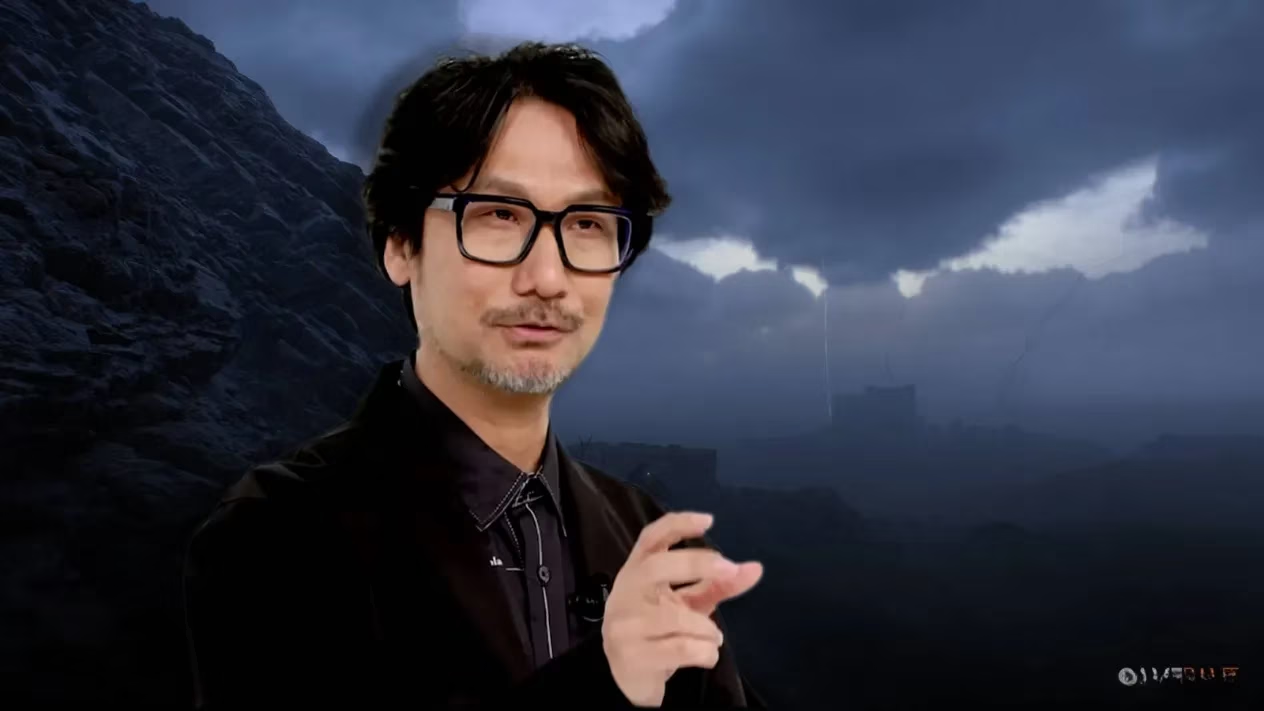
Kojima's Unconventional AI Ambition
In a conversation that turned heads, Kojima outlined a goal that seems plucked from science fiction. 🚀 "This might be out there, but I think I want to make a game played in weightlessness and a game that delights an AI," he stated. This idea forms the core of his unique stance. He elaborates that current AI systems are, in his view, not very knowledgeable. They are learners in need of a curriculum. Kojima's proposition is to design a video game that acts as that curriculum—a playful, engaging environment where an AI can be trained and learn. He envisions a future, perhaps 5 or 10 years from now, where an AI educated in this manner could "break into many different worlds." This is a far cry from the common industry focus on using AI for asset generation or automated dialogue. Instead, Kojima frames the AI as a player, or a student, with the game serving as its teacher. This perspective reframes the relationship between creator, player, and technology in a profoundly new way.
The Philosophy of "Something Really New"
This ambition for an AI-training game is not an isolated whim. It stems directly from Kojima's long-held critique of the industry's creative stagnation. He has previously expressed disappointment with the homogeneity of modern games, noting that "the visuals and systems are pretty much the same." For him, the imperative is clear: "it is important to put something really new in there for the industry." A game designed to train and delight an AI perfectly fits this mold. It is a concept that prioritizes systemic innovation and experimental interaction over graphical fidelity or traditional genre conventions. It's a continuation of the philosophy that made Death Stranding—a game about reconnecting a fractured society through deliveries—a surprise success. Kojima believes that truly novel ideas, no matter how strange they initially seem, are vital for the medium's evolution.

A Nuanced Stance in a Contentious Debate
Kojima’s vision exists within a highly charged industry-wide debate. The use of AI, particularly generative AI, remains one of the most contentious topics. Major concerns from both developers and players include:
-
Job Security & Labor Impact: Fear that AI will replace human artists, writers, and designers.
-
Originality & Soul: Worry that AI-generated content will lack the unique spark of human creativity.
-
Ethical Sourcing: Questions about the data used to train these AI models.
High-profile incidents have fueled this fire. Studios like Larian and Sandfall Interactive faced significant backlash after it was revealed they used AI in their development processes. Sandfall’s Clair Obscur: Expedition 33 was even disqualified from the Indie Game Awards for its use of generative AI art, despite being nominated for major awards. Other titles like Jurassic World Evolution 3 and The Alters have also admitted to using similar tools, showing the practice is becoming more common, if not more accepted.
In this heated climate, Kojima’s position is notably nuanced and selective. He has clarified that he is not interested in using AI to create art—the primary concern for many critics. Instead, his focus is on building dynamic systems. He gives the example of computer-controlled enemies that behave more realistically and can dynamically adapt to a player's unique actions and strategies. This application aims to deepen gameplay and create more immersive, responsive worlds, rather than cut corners on creative content.

Kojima as a Harbinger of Change
History has shown that Kojima's "strange" ideas often precede industry shifts. Metal Gear Solid popularized the cinematic stealth-action genre, and Death Stranding proved a deeply connective, asynchronous multiplayer experience could resonate globally. His current AI philosophy—training it through play, using it to enhance systemic depth, and explicitly avoiding its use for core artistic creation—may well be another instance of him predicting a viable future path. While the industry grapples with the ethical and practical dilemmas of AI, Kojima is sketching a blueprint for its constructive, innovative application. He is not advocating for an AI takeover, but for a collaboration where games become a medium for AI education and refinement.
The Road Ahead: Weightlessness and Wisdom
The other half of Kojima’s intriguing statement—a "game played in weightlessness"—remains shrouded in mystery. 🪐 While he hasn't elaborated, it aligns with his desire to break molds and explore sensations and mechanics untouched by conventional design. Could it be a literal game set in zero-gravity, or a metaphorical one about emotional or societal weightlessness? This, coupled with the AI-training concept, paints a picture of a developer relentlessly pursuing the outer limits of interactivity.
In 2025, as AI tools become more embedded and the debates around them grow louder, Kojima’s voice offers a different frequency. It is not one of fear or blind adoption, but of curious and intentional experimentation. He challenges the industry to think of AI not just as a production tool, but as a potential participant in the play itself. Whether his vision of a game that delights an AI comes to fruition, his perspective undoubtedly pushes the conversation forward, reminding everyone that the future of gaming has always been built by those willing to deliver the unexpected.