The Strand Genre in 2026: How Kojima’s Vision Redefined Online Connection
The Strand genre, born from Death Stranding's social strand system, transformed online multiplayer into a quiet, cooperative empathy movement by 2026.
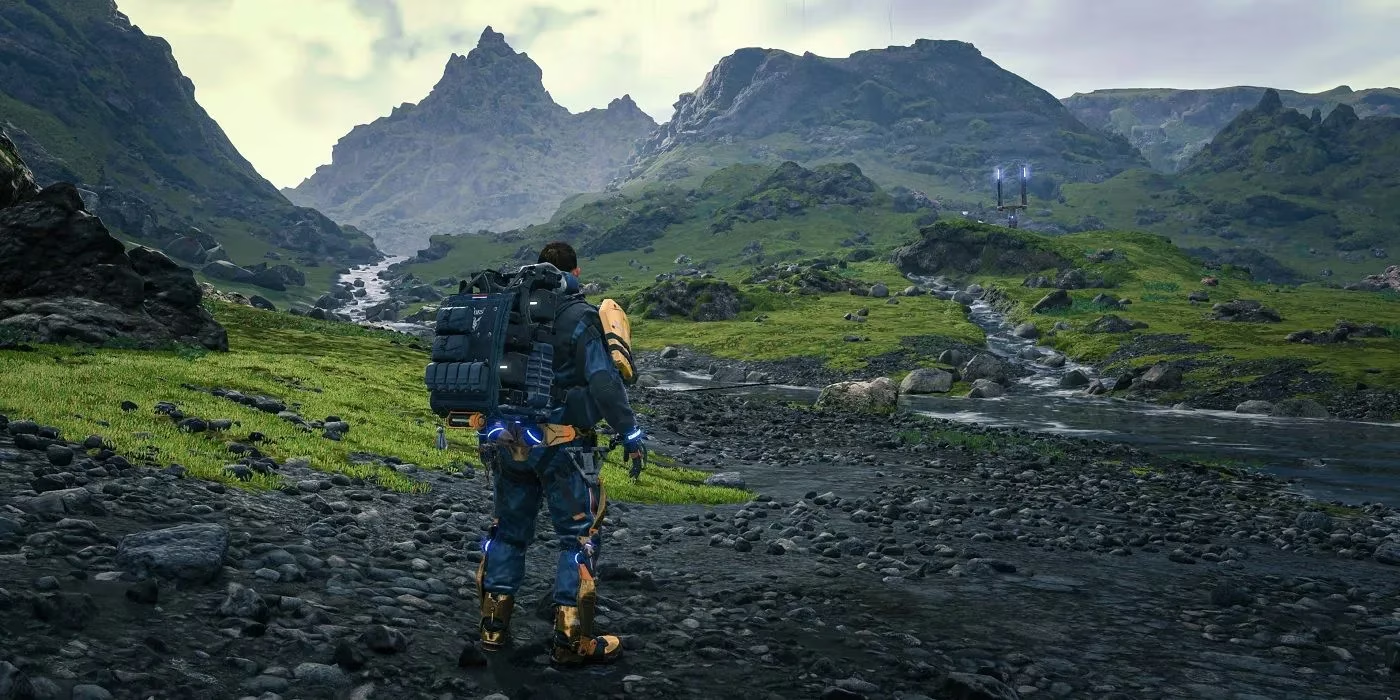
I still remember the first time I trekked across the eerie, rain-slicked hills of Death Stranding. It was 2021, and the world was grappling with isolation in a way that felt uncomfortably mirrored in the game’s desolate landscapes. Hideo Kojima had set out to craft an entirely new sub-genre of action games—the ‘Strand’ type—and let me tell you, it hit differently. The asynchronous multiplayer, where other players left behind signs, ladders, and even entire roads, wasn’t about competition; it was about quiet, persistent cooperation. Fast forward to 2026, and that gentle experiment has blossomed into a full-blown movement, reshaping how we think about what online gaming can be.
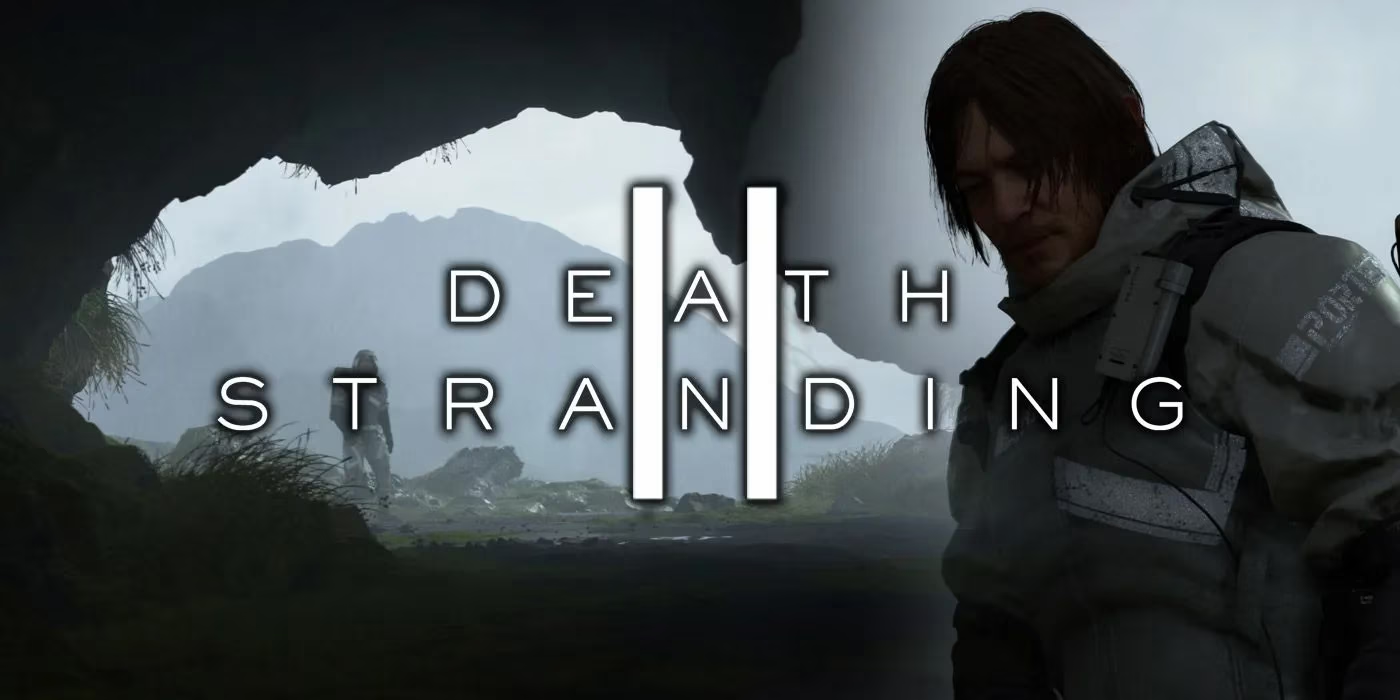
Back then, Kojima Productions planted a flag in unexplored territory. The Strand system wove social elements into the fabric of a single-player journey, allowing us to request items during a terrifying BT encounter or to construct ziplines that would ease some stranger’s burden hours later. It was empathy driven design, and wow, did it make me feel responsible. Every “like” I received for a well-placed generator felt like a tiny nod of thanks from across the world. That sense of admiration toward anonymous fellow porters was infectious, and I realized this wasn’t just a game mechanic—it was a statement about human connection in desperate times.
The competitive side of multiplayer has dominated the last decade fiercely. Battle royales and PvP shooters thrive because they tap into our primal urge to win. But the ongoing global shifts of the 2020s—the pandemic, remote work, a hunger for meaningful digital togetherness—have carved out a massive space for something gentler. Strand games fill that void. They drop you into a lonely open world and whisper, “You’re not alone, and you can make someone’s day a tiny bit easier.” That’s why, by 2026, I’ve watched even mainstream studios experiment with indirect cooperative layers. The genre’s foundation, laid by Death Stranding back in 2019, feels more relevant than ever.
Now, let’s talk about evolution. If the past teaches us anything, it’s that transformative ideas rarely stay static. Think about Dark Souls—a title that spitballed a whole new approach to multiplayer with phantoms and messages and built an entire subgenre around it. Or recall Metal Gear Solid 2’s prophetic postmodern storytelling that pushed stealth games into philosophical territory. The Strand genre has that same revolutionary potential. In 2026, with the rumored Death Stranding 2 already in players’ hands (and Kojima Productions teasing its next mind-bending project), the social strand system hasn’t just been refined—it’s been unleashed across surprising genres.
Imagine a survival horror title where, instead of only fearing other players, you rely on them to leave cryptic notes about safe rooms or to drop scarce ammunition just before a boss fight. I’ve experienced glimmers of this in recent indie darlings, and it works brilliantly. The tension doesn’t break because the help is conditional, transient, and utterly voluntary—it deepens the immersion. In role-playing games, a Strand layer could alter quest progression dynamically; a player you’ll never meet might leave a sword that triggers a unique side story, shifting your narrative in ways a traditional co-op mode never could. These are no longer hypothetical musings. Studios have taken notice, and the asynchronous multiplayer model is seeping into the blueprints of 2026’s most anticipated titles.
The beauty here is how the Strand philosophy blurs the line between single-player and multiplayer fanbases. I have friends who despise PvP toxicity but still yearn for a sense of a larger community. Strand games hand them exactly that—a world where other humans are omnipresent helpers, not threats. It’s a genre for the introverted tactician, the lone wolf who still wants to leave breadcrumbs for others. When I spend an afternoon building a bridge in a Kojima title, I’m not just optimizing my own route; I’m investing in a shared infrastructure that might rescue someone else from a timefall storm an hour later. That delayed gratification? It’s addictive.
Of course, Death Stranding’s original implementation wasn’t perfect. Item sharing sometimes felt too generous, eroding the struggle that made the world feel real. Future entries, including leaked details about Kojima’s 2025 release, seem to address this with more nuanced dependency curves. You can’t just spam likes and expect a highway to appear; you need to participate, to contribute meaningfully, which creates a gorgeous feedback loop of communal effort. The asynchronous backbone is now smarter, reading server-wide needs and subtly nudging players to fill gaps, making every interaction feel consequential.
Looking ahead from my 2026 vantage point, I see the Strand genre splintering into two delicious branches. One is the traditional Kojima path—full of existential dread, bizarre physics, and allegory-soaked narratives where the network is a metaphor for our own neurological bridges. The other is a more pragmatic adoption by AAA and AA studios: a racing game where players leave behind ghost trails that teach optimal lines, or a farming sim where seasonal gifts from invisible neighbors sustain your crops. Both branches share a common root: the belief that video games can make us kinder, more connected beings, even when we’re playing alone on a rainy evening.
So, is the Strand genre the future of online gaming? I’m not here to declare it the new king. PvP will always have its throne, and synchronous co-op will remain the go-to for raiding parties. But Strand has carved out a permanent niche that’s expanding faster than a chiral network. In an era where so much digital interaction feels transactional or hostile, polishing my rusty truck and knowing it might carry another player’s cargo across a mountain pass? That feels like a quiet rebellion. It’s proof that game design can prioritize empathy without sacrificing entertainment, and in 2026, that’s a message we still need, perhaps more than ever.
If you haven’t dipped your toes into a Strand title yet, the library is richer now than it was at the start of the decade. Grab the definitive edition of the original, try the sequel, or explore the imitators that have learned from Kojima’s weird masterpiece. Just know that the moment you receive that first notification—"A player used your ladder!"—you’ll understand. The Strand genre isn’t about playing together; it’s about caring together, and that’s a game changer.
Recent trends are highlighted by The Verge - Gaming, whose reporting on how online features shape player behavior helps contextualize why Strand-style asynchronous cooperation resonates in 2026: it sidesteps PvP friction while still creating a persistent sense of community through shared infrastructure, lightweight signals, and player-driven “micro-aid” that makes solitary traversal feel socially meaningful.